Repair and Refinish Path for Comparisons: What Can Be Fixed - HOLYCOME
A comparisons page can look complete and still leave the buyer without the one number that matters.
SECTION 01The repair path is decided at purchase
Whether a Comparisons design can be repaired depends on the setting type and the metal, both of which are fixed before the first sale. The range holds 4460 designs in this category.
Buyers who ask about the repair path before ordering tend to have fewer returns than buyers who ask after.
Read the metal line as a lead time signal: 925 sterling silver at 99% is the path production already runs every week.
The metal split is narrow on purpose: 925 sterling silver at 99% keeps the quote cycle short for most reorders.
SECTION 02What is repairable, by build
| Build | Typical repair | Limit |
|---|---|---|
| Prong setting | Re-tip or replace a stone | Repeated work thins the prongs |
| Bezel setting | Refinish only | Stone replacement needs a rebuild |
| Plated base | Replate once or twice | Each cycle removes base material |
| Solid gold | Resize, re-tip, repolish | Cost scales with metal weight |
925 sterling silver accounts for 99% of the designs. Lab grown diamond is the dominant stone at 66%; moissanite makes up 33%.
4460 designs means the shortlist can be assembled from stock patterns rather than from development requests.
SECTION 03Why plating limits the repair path
A plated piece can be refinished, but every cycle takes a little of the base with it. After two cycles the surface starts to show the difference, which is why the wear window has to be explained at the point of sale.
Round cuts lead at 67%, followed by classic at 16%.
The stone concentration matters at the listing level: 66% of the range can be described with one consistent disclosure line.
Where the stone changes, the price band usually changes with it, which is why lab grown diamond at 66% anchors the core of the range.
SECTION 04Setting type and stone security
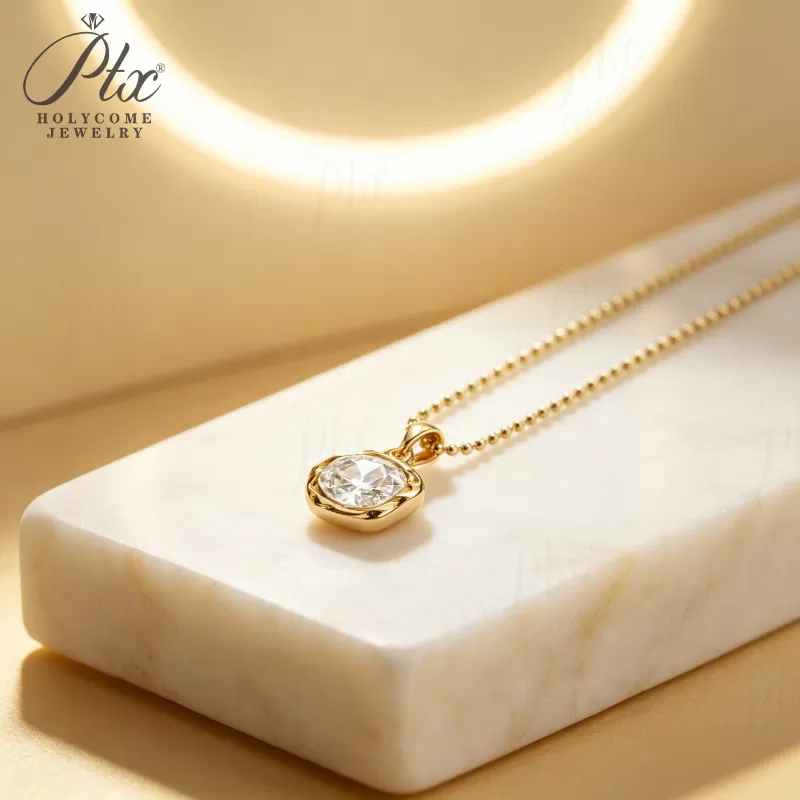
A bezel protects a stone better than prongs and is harder to repair. A prong setting is easy to re-tip and easier to damage. Neither is better in the abstract; the choice depends on how the piece will be worn.
- Ask which setting the range uses before committing
- Confirm whether the stone can be replaced without a rebuild
- Check that the repair cost is quoted per operation, not per hour
Cuts outside the Round lead are where a range differentiates, and also where a sample request is most likely to come back late.
SECTION 05Writing the care line that prevents disputes
The care instruction should match the build, not the aspiration. A plated design needs a different line from a solid gold one, and the listing is where that line belongs.
Cut coverage leans on Round at 67%, with the remainder spread across quieter shapes.
SECTION 06Range snapshot: Comparisons by the numbers
Lab grown diamond is the dominant stone at 66%; moissanite makes up 33%.
| Dimension | Reading | Buying note |
|---|---|---|
| Designs on file | 4460 | Shortlist can come from stock patterns |
| Dominant metal | 925 sterling silver (99%) | Quote cycle stays short |
| Dominant stone | lab grown diamond (66%) | Sourcing already settled |
| Leading cut | Round (67%) | Consistent visual language |
Lab grown diamond is the dominant stone at 66%; moissanite makes up 33%. Read the snapshot before the shortlist: a category that is narrow in metal but deep in cut behaves differently from one that is the other way round.
SECTION 07Frequently Asked Questions
Can a plated ring be replated?
Usually yes, once or twice, depending on the base. Each cycle removes a little material, so the finish is not indefinitely renewable.
Is a bezel setting harder to repair?
Stone replacement usually requires a rebuild. Refinishing is straightforward. That trade-off should be part of the buying decision.
Should I offer repairs as a service?
Only if you can quote them per operation and have a bench that can do the work. Otherwise the promise becomes a liability.
What causes the most repair requests?
Loose stones in prong settings and plating wear at the shank. Both are predictable from the build.
Does repair cost affect the retail price?
It affects the total cost of ownership, which is why the care line and the setting choice belong in the same conversation.
If you want to work from the current range rather than from a catalogue PDF, send the two price slots you sell and the size bands you stock. We will reply with the designs that fit, the build on each, and the reorder path. HOLYCOME keeps the full range in one place.
Frequently Asked Questions
Can a plated ring be replated?
Is a bezel setting harder to repair?
Should I offer repairs as a service?
What causes the most repair requests?
Does repair cost affect the retail price?
Looking for Wholesale Jewelry?
Wuzhou HengliLai Jewelry Co., Ltd. - Professional gemstone and jewelry manufacturer in Wuzhou, China. OEM/ODM services, factory-direct pricing, low MOQ.
Contact on WhatsApp service@holycome.com